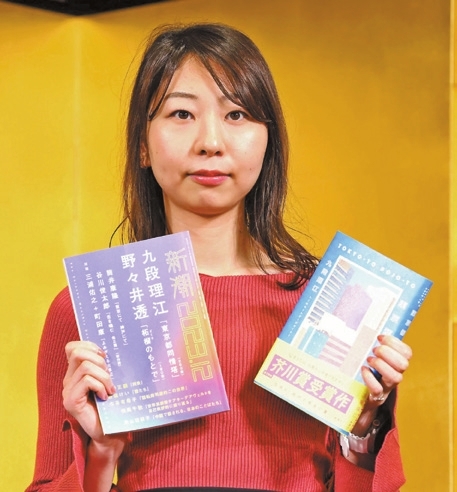
Rie Kudan, the 33-year-old winner of Japan’s top prize for literature, revealed last Wednesday that she used ChatGPT to write a portion of her book. Kudan won the prestigious Akutagawa Prize for her sci-fi novel “The Tokyo Tower of Sympathy,” which centers around a high-rise prison tower and contains themes surrounding AI. Judges reportedly called Kudan’s novel “almost flawless.” The Akutagawa Prize is Japan’s top prize for pure literature, and is awarded semiannually to emerging writers. The related Naoki Prize goes to established authors of popular fiction. It’s a huge deal, and the winners of these prestigious awards typically receive tremendous amounts of media attention. In her acceptance speech, Kudan revealed that a portion of the book had been written by ChatGPT. “This is a novel written by making full use of a generative AI like ChatGPT, and probably about 5% of the whole text is written directly from the generative AI,” Kudan said, according to The Japan Times. “I would like to work well with them to express my creativity.” The Japan Times reported Friday that the reaction on social media was swift and harsh, with many people expressing concern about what the future of literature will be if AI is allowed to compete for top awards. The use of generative AI in creative fields is still highly controversial, in part because such systems are trained on a massive corpus of other authors’ work. AI systems are known to regurgitate texts they were trained on wholesale, including personal information from real people scraped from the internet. Some observers noted that Kudan’s book contains sections that are meant to be responses generated by an AI, and argued that if ChatGPT was responsible for those portions of the book, that would be more defensible. Kudan’s publisher did not respond to a request for comment sent by The Japan Times. Kudan’s novel is set in an imagined near future where AI has become an integral part of daily life. It follows the story of Sara Makina, an architect who builds a tower in a Tokyo park designed to offer a place where criminals are rehabilitated and explores her discomfort with society’s tolerance towards those who break the law. Outside of her literary work, Kudan says she often plays around with AI and uses the technology to share thoughts that she “can never talk to anyone else about.” Admitting to using it in her writing, apparently, wasn’t one of them. Kudan added that she hopes to maintain “good relationships” with the tech and use it to “unleash my creativity” with it going forward, according to AFP. In 2022, the Colorado State Fair’s fine arts competition was embroiled in controversy when a prize in its “digitally manipulated photography” prize was given to a piece created in part with Midjourney, an AI-powered image-generating tool. Then last year, an artist turned down their prize from the Sony World Photography Awards because their prize-winning photograph wasn’t actually a photograph at all, but rather a digital image made using the AI program DALL-E 2.(SD-Agencies) Words to Learn 相關(guān)詞匯 【照搬】 zhào bān regurgitate repeat what you have heard without thinking about it 【有爭議的】 yǒu zhēngyì de controversial causing disagreement or discussion 33歲的日本最高文學(xué)獎(jiǎng)得主九段理江上周三透露獲獎(jiǎng)作品的部分是她使用 ChatGPT 撰寫的。 九段憑借科幻小說《東京同情塔》獲得了著名的芥川龍之介獎(jiǎng),該小說圍繞一座高層建筑中的監(jiān)獄展開,主題與人工智能有關(guān)。據(jù)報(bào)道,評委稱九段的小說“幾乎完美無瑕”。芥川獎(jiǎng)是日本純文學(xué)獎(jiǎng)中的最高獎(jiǎng)項(xiàng),每半年頒給一位新銳作家。而相應(yīng)的直木獎(jiǎng)則頒發(fā)給知名的通俗小說作家。該獎(jiǎng)影響巨大,獲獎(jiǎng)?wù)咄ǔ艿矫襟w的廣泛關(guān)注。 九段在獲獎(jiǎng)感言中透露,書中有一部分內(nèi)容是由 ChatGPT 撰寫的。《日本時(shí)報(bào)》引用九段的原話說:“我的寫作過程充分利用了ChatGPT 這類生成式人工智能,全文大概有5%直接由人工智能寫成。我希望能很好地利用人工智能表達(dá)創(chuàng)意。” 據(jù)《日本時(shí)報(bào)》周五報(bào)道,社交媒體上的反應(yīng)迅速而嚴(yán)苛,許多人擔(dān)心,如果允許人工智能角逐最高獎(jiǎng),文學(xué)的未來將走向何方。在創(chuàng)作領(lǐng)域使用生成式人工智能仍存在很大爭議,部分原因是這類系統(tǒng)是利用其他作家的大量作品語料訓(xùn)練出來的。 眾所周知,人工智能系統(tǒng)會全盤照搬用來訓(xùn)練它們的文本,包括從互聯(lián)網(wǎng)上搜羅的真實(shí)個(gè)人信息。 一些觀察家注意到,九段書中部分內(nèi)容是人工智能生成的回復(fù),他們認(rèn)為,如果ChatGPT只是貢獻(xiàn)了這部分內(nèi)容,那么這個(gè)獎(jiǎng)拿得就理直氣壯。九段的出版商沒有回應(yīng)《日本時(shí)報(bào)》的置評請求。 小說以想象中的不遠(yuǎn)的未來為背景,那時(shí)人工智能已成為日常生活不可或缺的一部分。小說中,建筑師牧菜在東京一個(gè)公園里建了一座塔,用來為罪犯提供一個(gè)改造場所。故事還探討了牧菜對社會寬容違法者的態(tài)度感到不適。 九段說,文學(xué)創(chuàng)作之外她也常常使用人工智能,對這種技術(shù)工具分享她“永遠(yuǎn)無法與他人傾訴”的想法。顯然,這和她使用人工智能輔助寫作是兩碼事。據(jù)法新社報(bào)道,九段補(bǔ)充說,她希望與這項(xiàng)技術(shù)保持“良好的互動”,并在未來繼續(xù)利用它“釋放創(chuàng)造力”。 2022年,美國科羅拉多州博覽會的美術(shù)比賽因其“數(shù)字藝術(shù)類”獲獎(jiǎng)作品部分由人工智能圖像工具M(jìn)idjourney生成而引發(fā)爭議。去年,一位藝術(shù)家主動拒絕了索尼世界攝影大賽的獎(jiǎng)項(xiàng),因?yàn)樗墨@獎(jiǎng)作品實(shí)際上不是照片,而是使用人工智能程序DALL-E 2生成的數(shù)字圖像。 (Translated by Debra) | 