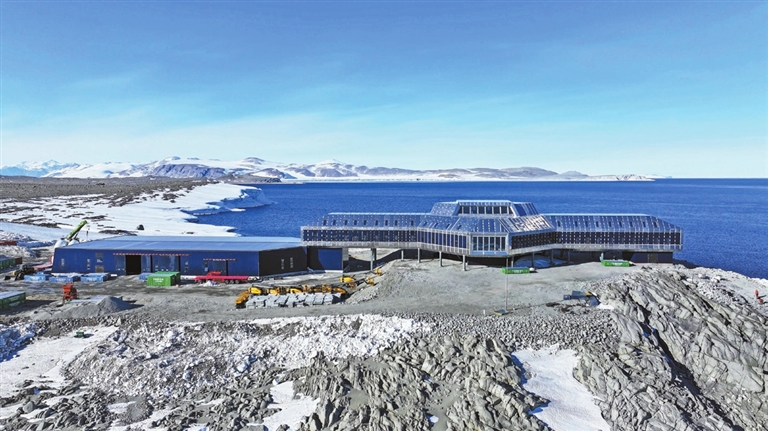
DOZENS of construction personnel on China’s 42nd Antarctic expedition will complete the building of the country’s fifth Antarctic base, Qinling Station, next February, according to a Sunday report by State broadcaster CCTV News. The report stated that 22 personnel from the new expedition will join members of the ongoing 41st Antarctic Expedition for the construction mission. Their tasks include finishing the interior decoration, fitting mechanical and electrical facilities in the main station area, constructing an observation wing, and maintaining new energy power systems. Cao Tao, chief engineer for the Antarctic project from China Railway Construction Engineering Group, noted that the construction period coincides with the Antarctic polar day. To enhance precision and minimize environmental impact, the interior construction will adopt shipbuilding outfitting techniques, with all prefabricated components assembled on-site. All construction materials are custom-made and eco-friendly. According to Li Junsheng, a deputy chief engineer from the Command Center for Comprehensive Survey of Natural Resources under China Geological Survey, the primary material, calcium silicate, is stable and difficult to decompose, containing minerals widely found in nature. These materials have an A-level fire resistance rating and moisture resistance capable of withstanding the prolonged dampness of the Antarctic polar night, with a service life of over 50 years. A key feature of Qinling Station is its advanced smart facilities, which distinguish it from China’s previous Antarctic bases. The station’s smart storage system can track stocks in real-time and automatically send an alert back to China when supplies run low. Its integrated safety platform can detect heat, smoke, or harmful gases and send alarms to both team members and the domestic monitoring center within 10 seconds. During the polar night, technicians in China can remotely adjust temperatures and ventilation, and guide on-site repairs via high-definition cameras to avoid risky night-time operations. In addition to work on Qinling Station, team members will also develop the Zhongshan Station into an Antarctic scientific research information hub. Project manager Zheng Di said that once complete, the project will significantly improve the real-time transmission speed of research data and provide more stable data communication for research projects such as glacier and atmospheric observation.(SD-Agencies) | 